25 June 2006

Greenland: Social and environmental ramblings, part 2

While in Ilulissat, Martin and I met with the people that run the local museum. They are also the people who denied our original permit application. (I mentioned this some time ago.) The conversation we had with them was, for me at least, informative, eye-opening, and very interesting.

Sermeq Kujalleq is within a very new World Heritage Site that still lacks a clear management plan. The main issue with the World Heritage Site is that it has been used by natives for many many years for hunting and fishing. Now these people are being denied access to parts of the park for biological, archaelogical, or philosophical reasons. This is ultimately why our permit application was denied - they certainly couldn't tell the locals that they are no longer allowed to travel there but then allow scientists from other countries to go and do whatever they please. Fair enough.

The more interesting part of the conversation was that they are very interested in science outreach. They said that many scientists pass through Ilulissat each year to study the ice sheet, the biology, depression, alcoholism, etc., but none of the locals really know what the scientists are doing or what they are finding. I think that's a shame.

The people at the museum (a Dane and a Dane/Greenlander half-breed) were hoping that we could begin an open discussion with the community about our work and our findings. This discussion could also be beneficial to us, the scientists, in that we're not able to be in Ilulissat all the time. We don't really know how the glacier or ice fjord look now compared to 20 years ago. The locals do, of course. Anyway, the museum folks had plenty of ideas. They thought that Martin (and others?) should give some talks in town and maybe write a letter/article to the newspaper. We also met with a native woman who produces a popular television show in Greenland - I guess the show is informative and educating, sort of a cross between the news and a talk show. She said she'd like to do a show on our work and discuss its implications. She'd also have discussions with local hunters and fishermen (who are affected by the glacier since it can influence ocean currents and the number of icebergs in the fjord).

Finally, during the course of our conversation I told the museum folk that I was thinking of spending an entire summer in Ilulissat (this is a new dream) and that during that time I would be willing to do some outreach. They were very keen on the idea, and suggested that they could probably get me free housing if I helped them set up an interpretive display (basically, how does a glacier work). There are still many details that would need to be sorted out before this happens, but it sounds like an experience (both personal and educational) that I couldn't easily refuse.

Greenland: Social and environmental ramblings, part 1

Returning to town early was nice - we were able to enjoy showers, soft beds, and tasty food. Surprisingly, the restaraunts in Ilulissat can rival just about anything else in the world, and are probably the best north of the arctic circle. One of the restaurants regularly has the "Greenland buffet", which consists of basically every edible creature in Greenland, many of which are probably endangered or on their way to being endangered. I didn't order the Greenland buffet (too much meat for me), but Martin did and he offered me some samples: polar bear soup, seal, fin whale, and musk ox. I found them to be edible but not great. And now I feel a little guilty that I ate animals whose populations are threatened.

The restaurant owner told us that, according to international rules, the Greenlanders are allowed to kill a set number of seal, whales, and polar bears each year, but they usually don't follow international rules. If the hunters see an animal, they kill it. I don't blame them, to a certain extent. They had a way of life (living on whatever they could kill) that was sustainable for thousands of years, but then other cultures began hunting those animals towards extinction, and now it is the Greenlanders who suffer. If they can't eat whale, then what do they eat? Shipping food from Europe or North America isn't sustainable or affordable. On the other hand, the world has become a smaller, more densely populated place and everybody needs to think more globally, including the Greenlanders. I think all arctic peoples are struggling with the adjustment to a more global, modern world. Traditionally, they hunted whatever they could because they never knew when they would see their next meal. This was okay; populations were smaller since people didn't live as long. But in the modern, highly-populated world this behavior could have catastrophic effects on the biosphere and ultimately on the Greenlanders way of life. Of course, they don't see it that way - in their minds they're just being told what to do by outsiders. The real difficulty, I think, is in trying to maintain traditional ways of living while integrating the comforts of modern life. And although scientists, sociologists, etc., can help them find the balance between the traditional and modern worlds, we are not in the position to say what is best for them. They need to figure that out themselves.

Greenland: The final weeks of field work

Roman and Mark left us after two weeks of beautiful weather and no mosquitoes. Once they left, the mosquitoes came out and it started to rain and snow. For the next ten days we (Martin and I) were not in high spirits. We had hoped we could do some hikes and enjoy the area more than we were able to. We continued with our surveys of the terminus when possible but otherwise spent a lot of time in the large group tent reading, playing cards, processing data, and drinking coffee. I discovered on this trip that coffee is actually pretty good if you put a little bit of sugar in it. We finally pulled camp after 10 days and headed back to Ilulissat. There was still work to be done on the glacier, but it could be done by commuting from town - the helicopter had to travel that distance from town anyways. Being in town allowed us to organize and store all of our gear during days that we weren’t flying to the glacier.

24 June 2006

Greenland: Camp life

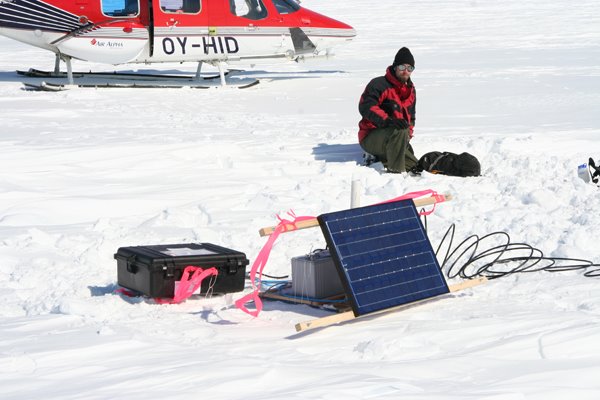
The first week in camp was hectic. We were busy establishing camp, further testing our equipment, and deploying the instruments. During the next few weeks there was a lot of down time, except during the few remaining days that we spent relocating GPS stations. All that was left to do was to download the weather station and ablation meter data, check on the cameras, download data from two GPS that were radio-linked to camp, and survey the mirrors every three hours (regardless of time or weather).

The two radio-linked GPS stations malfunctioned after 4 days (bummer) and a major calving event sent two of our mirrors to the bottom of the fjord (bummer). One of the surveying mirrors was now located on an iceberg and could be viewed from camp – by surveying its vertical position and estimating melt rates and tidal range from our tide gauge, we hope to be able to estimate the amount of melting that occurs below the water surface. I started surveying it once every hour, except during my sleeping hours. Others surveyed it while I was sleeping, so we ended up with a pretty nice record. (The astute reader might note that nowadays surveyors tend to use automatic instruments that do everything for you – we couldn’t afford to buy anything newer so we are still using surveying equipment from the 70s. That’s okay though, because the old surveying instruments are beautiful tools and fun to use.)

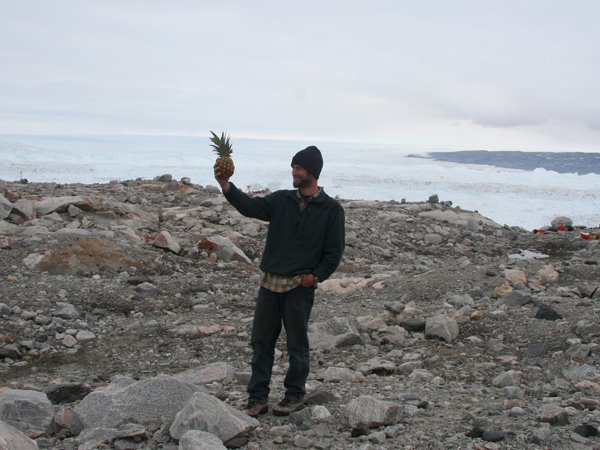
We brought most of our food with us when we first set up camp, but were occasionally resupplied with very good bread and cheese (Danish colonization isn’t an entirely bad thing…) and even a pineapple. The pineapple was a wonderful surprise. It made up for the fact that Roman accidentally brought several kilograms of muktuk (whale blubber) from Ilulissat, thinking that it was some sort of white fish. Muktuk tastes kind of like greasy leather. Actually I thought it was okay in small quantities, but not as a full dinner.


The lack of things to do, the repetitive nature of surveying the markers and the sun travelling in circles through the sky gave a sense of timelessness. Soon my schedule was nearly flipped upside down.

I had a lot of time to think – sometimes too much. Thinking was something that I hadn’t been able to do much of lately. And I mean really think. What am I doing with my life? Onko suomea vaikea kieli, vai olenko vain laiska? (Is Finnish really a difficult language, or am I just lazy?) Why is this glacier so messed up?


We also passed the time taking hikes, reading books, processing data, playing cribbage, watching the icebergs move past, and seeing how many mosquitoes we could swat with one swing. Martin set the record: 21 killed with just one slap on his arm.

Greenland: Scientific agenda

As I described in a previous entry, Sermeq Kujalleq is currently experiencing a rapid retreat and acceleration, as are pretty much all glaciers in southern Greenland. The retreat rates are truly exceptional. 10 years ago no glaciologist would have thought that this sort of behavior was possible on a large ice sheet. The purpose of our study is to attempt to understand not only what is driving this retreat, but also to try to predict to what degree this will affect the entire Greenland Ice Sheet. To this end we will use satellite and field data, as well as numerical modeling. There are four principal investigators on the project and myself, and each brings a distinct slant to the project. Martin is the GPS/flow dynamics expert, Roman brings knowledge of tidewater glaciers and fjord systems, Mark is the remote sensing expert, and Tinu is the modeler. Its still not clear where I will fit in, but it seems that I will most likely be doing a substantial amount of modeling.

Sermeq Kujalleq is very large and difficult to travel across; we are therefore relying entirely on helicopter support. We have deployed 4 “continuous” GPS sites along the main channel of the glacier. These sites will hopefully run for 2+ years and give us information regarding the seasonality of the flow field. We have also deployed 7 “temporary” GPS sites on the nearby ice sheet to see how much the ice sheet is affected by the acceleration and retreat of the main channel. These sites were only occupied for 1-2 weeks and then moved to a new location. They will be redeployed next year to see what changes, if any, have occurred.


Since we feel that the glacier’s stability is largely influenced by what’s happening in the ocean, we also have some interest in studying the processes at/near the terminus. So on our fourth day of flying we had the pilot remove one of the doors so that we could drop surveying mirrors onto seracs (ice towers) – these mirrors could be surveyed from camp. (Don’t worry Mom, it wasn’t me hanging on to the outside of a hovering helicopter – I was at camp making sure that we could see the mirrors.) That same day we put out two additional GPS; one was low on the glacier, the other was on top of a large overturned iceberg. I think I can say that that was the first time that I had stood on ice that used to be at the base of a glacier. Pretty cool.

Finally, we set-up a weather station (temperature and precipitation), an ablation meter (measures melt rates), two time-lapse cameras, and a tide gauge.

23 June 2006

Greenland: Camp site

We flew about 50 km due east of Ilulissat and set up camp on a bedrock ridge close to the ice stream. From there we had great views of the glacier terminus and icefjord. Its difficult to describe the immensity of the place. Its even more difficult to capture it with a photo.


At first glance the site looked like a completely desolate place – just rock and ice – but summer had not yet arrived. Soon the remaining snow patches melted, the ponds dried up, and the flowers started to bloom in succession. I wish I knew the names: first purple flowers, then white, then yellow. Birds began passing through with increasing numbers: ravens, geese, ptarmigan, buntings, and an owl. We didn’t see any signs of larger life, but that’s fine by me – no polar bears came crashing through our campsite. Actually we had been told beforehand that bears don’t come through this area, but you never know…


The glacier was overwhelming at times. The ice flux through the terminus is about 50 km3 of ice per year – I think that’s something like 50 times the amount of water that Los Angeles uses in a year. The sounds of crevasses opening and closing, ice calving off the terminus, and icebergs grinding against each other reminded me of thunder (and growling bears). On a couple of occasions we documented enormous calving events with time-lapse photography. I hope to post a video of those events in the future. The terminal cliff may be the largest ice cliff in the world – it rises over 100 m above the water surface.

Greenland: Ilulissat (meaning: icebergs)

Ilulissat may be the most spectacular place that I’ve ever been. It is a traditional village and is populated primarily by Greenlanders, though you do see quite a few Danes running around as well. The houses are colorful and typical of what you might expect to see in Scandinavia. The town sits on the outer coast and just north of the Kangia Icefjord, which is fed by Sermeq Kujalleq (Southern Glacier). Its called an icefjord (instead of just a fjord) because of the steady stream of large icebergs that travel out to the ocean. The fjord is so packed with ice that you often can’t see any water. On a side note, most fjords in west Greenland have a "Northern Glacier" and a "Southern Glacier", so the name Sermeq Kujalleq is not particularly useful to those of us with western minds.


From Ilulissat you can watch fishing boats weave through the icebergs at all times of day. With 5000 people and 5000 sled dogs its actually a pretty busy place. It has several grocery stores, restaurants, bars, hotels, and a hostel. The local orienteering club meets on Mondays and the kayaking club meets on Tuesdays. I’m not sure what else is happening, but there seems to be plenty to do. Plenty for the tourists as well, and it seems that its only a matter of time until Ilulissat is “discovered”, which I think is unfortunate. Its nice to know that there are still amazing places in the world that don’t have jewelry stores and t-shirt shops on every street corner. But at least I can say that I was there before it became a major tourist destination.


We spent one day in Ilulissat going through all of our gear that was shipped ahead of time and double checking that we had everything. We also tried to trim down our gear as much as possible so as to limit the amount of helicopter trips we’d need to get everything to our camping site. It ended up taking three trips to haul 4 people plus about 5000 pounds of food, camp supplies, and scientific equipment. That’s an expensive camping trip, since the helicopter runs at $3000 an hour (we needed two hours to get everything to camp). Thank you NASA.

Greenland: The Journey

I flew from Fairbanks to Albany, NY on May 19 – in a little over 14 hours. We spent about one day in Schenectady, NY running some last minute errands and dreaming of ice. (Speaking of which, a passenger on my flight to NY asked me why I’m doing field work in Greenland instead of the Caribbean. Good question.) On May 21 we took a taxi to the Air National Guard Base at 4:30 a.m. I remember thinking that that would be the last time I’d see the moon shining brightly for some time.

We flew with the Air National Guard to Kangerlussuaq, Greenland. We and about 30 other beakers (scientists) checked in at the base and sat around waiting to board and depart. There were three planes headed for Greenland, two carrying air national guardsmen and guardswomen, and one with scientists. It was an interesting atmosphere – 30 scientists excited to be on their way to Greenland and about as many guardspeople who viewed a trip to Greenland as a prison sentence.


The military jet we flew on had no amenities. We sat on seats made essentially of cargo straps. The plane was loud enough that we had to wear ear plugs the entire flight, which lasted about 6 hours. The “bathrooms” consisted of a toilet and a curtain that you pulled around you. I guess the military isn’t too big on privacy. The few guardsmen on our flight pulled out stretchers and hammocks and slept most of the way.


We arrived in Kangerlussuaq sometime in the afternoon and were met by the friendly folks at VECO, our logistics provider. Kangerlussuaq (long fjord?) isn’t the most exciting place in Greenland. It may be as far from the coast as you can get in Greenland without being on the ice sheet, yet you can’t see the ice. The town was developed as a military air base – its one of the only places in Greenland where you can land large jets – and as you might expect the town lacks character. All of the buildings look like rectangular lego pieces. But we were excited - Greenland! After eating dinner we sat around discussing our field plans – this was the first time that the four of us (myself, my advisor Martin, Roman from Juneau, and Mark from New Hampshire) had a chance to sit down and talk since the AGU meeting in December.

The next day we flew onward to the town of Ilulissat.

Work completed

We've managed to finish our field work a week ahead of schedule and are now trying to change our tickets to fly to Europe sooner than originally planned. This is turning out to be quite difficult, so we may be "stuck" in Greenland for about one more week. In the mean time I'm staying at a hotel of sorts (for scientists working in Greenland) and have unlimited access to the internet. I'll post several descriptions and photos of Greenland over the next few days.

18 May 2006

Actually, one interesting thing...

I guess there was one very exciting thing that has happened in the past week. I received a young researcher travel award that will cover travel and accomodations for a one month stay in Wellington, New Zealand, this coming winter. I've been in contact with a researcher down there and we're working on ideas for possible collaborations. Not sure what will happen yet, but I'm sure it'll involve some field work and interesting discussions. Maybe (and hopefully) it'll lead to something bigger.

I'm off!

A hectic few weeks will come come to a close when I step on the plane for Greenland tonight (via New York). Again, sorry about the lack of updates lately, but there hasn't been time or anything interesting to write about. But I promise there will be plenty of pictures and stories of icebergs, isbræ, and slots when I return in July. Until then... Have a great summer!

05 May 2006

Greenland drama

As I mentioned previously, it's been a lot of work getting ready for field work in Greenland. Almost everything's been taken care of. Most of our gear is already on its way, we've got airline tickets, hotel reservations, maps, and a big grocery list. Except for two small details, we're set! Right... Yeah, except those two small details are actually pretty big deals. Last week we found out that we couldn't get a permit to operate our radio antennas, which we need in order to download GPS data remotely. The radios would help us to locate our GPS receivers after they've travelled for a year (they probably won't be that easy to find amongst all that ice!). And this week we received a permit to work near the glacier - its a World Heritage Site. But the problem is that we aren't allowed to go where we want to go for camping, optical surveying, and photography purposes. The strange thing is that people camped there last year without any troubles. And what makes this ironic is that a glaciologist was instrumental in turning the fjord into a World Heritage Site (because the glacier/fjord system is very unique), and now glaciologists aren't allowed to go there to study it. Well, anyway, the permit was a little vague so there's still hope, though we are leaving in two weeks....

One thing is for certain though - we'll be going to Greenland, just not sure what we'll be doing!

Save the world!

Ban dihydrogen monoxide. Find out more by clicking here.


How gullible are you?


20 April 2006

Onward to Greenland

A month from now I'll be on my way to Jakobshavns Isbrae, a glacier in western Greenland. I'll travel from Fairbanks to Albany, NY, via commercial airlines. From there we'll fly on an Air National Guard plane to Kangerlussuaq, Greenland, and then hop on a smaller plane to Ilullissat. We'll spend a few days in Ilullisaat organizing gear and double-checking everything, and then we'll take a helicopter to our camp site located at the terminus of Jakobshavns (or Sermeq Kujalleq, in Greenlandic). Check it out on Google Earth: our camp site will be located at about 69°07'30"N, 49°43'48"W. The fjord in front of the glacier that is now filled with brash sea ice was occupied by the glacier as recently as 200 years ago. The current terminus position is actually about 5-10 km back from where it appears in the Google Earth image. Sermeq Kujalleq drains 7% of the Greenland ice sheet, is up to 2500 m thick, and flows at a rate of about 15 km/yr at the terminus. Its impressive, so I'm told.

We'll be in the field for about 6 weeks, and then returning to Fairbanks via Copenhagen... We aren't able to fly with the Air National Guard on our return trip so we're forced to take the scenic route. The benefit is that we get to meet with some researchers in Copenhagen - and I'm going to take few days off and explore the city and its surroundings. So if you're going to be in the area... Let's meet!

Something about CO2

From ice core data we have learned definitively that there is a link between CO2 and global air temperature. The following figure shows CO2 concentration and air temperature (from some reference value) as determined from an ice core in Antarctica. Similar patterns have been found in all ice cores.


The C02 concentrations are measured in air bubbles within the ice core. Air temperature is approximated by measuring oxygen isotopes within the ice crystals themselves. Essentially, isotope fractionation occurs when water evaporates from the oceans - since oxygen-18 is heavier than oxygen-16, water molecules containing O-18 require more energy to be turned into water vapor than water molecules containing O-16. Thus the water vapor tends to be "isotopically lighter" than the oceans it has left behind. The water vapor travels poleward (due to temperature/pressure gradients) and encounters colder temperatures. Cold air can't hold as much moisture as warm air so the water vapor condenses and falls as snow or rain. Again, because it is heavier, the O-18 tends to precipitate sooner than the O-16. So it requires rather warm temperatures at all latitudes for O-18 to be found at the poles, and it can therefore be used as a proxy for air temperature.

The large, 100,000-year cycles in air temperature are what are referred to as glacial cycles. There is quite a bit of evidence that suggests that they are controlled by orbital parameters, such as the tilt of the Earth's axis, the ellipiticity of its orbit, and precession (the Earth wobbles like a top over a long time scales). Other factors are also clearly important, such as the distribution of land mass, which is important over much larger timescales (millions of years).

As I mentioned early, there is a strong correlation between atmospheric CO2 concentrations and air temperature, but from the plot above it is very difficult to determine what comes first - a change in CO2 or a change in temperature. (Methane also experiences similar oscillations.) And in fact there are reasons to believe that a rise in temperature can drive CO2 (and methane) concentrations - it can, presumably, force CO2 out of the oceans (and methane out of swamps that were previously frozen). But on the other hand, CO2 is also a "good" greenhouse gas that can trap solar radiation - more on that in a later post.

Two things to note from this figure: (1) the current interglacial period is the longest in the recent geologic past, and (2) CO2 concentrations are currently rising very rapidly and are much higher than any time in the past 400,000 years. I will also discuss this in a later post with respect to what's happened over the last 100 years - since the industrial revolution.

11 April 2006

Field prep

Sorry about the lack of updates lately - it's been a hectic couple of months and I don't think it will get much better anytime soon. Most people would probably take a break after defending their thesis, but not me. I'm busy running in circles trying to get equipment ready for field work. We have to have almost everything sent and on its way through Greenlandic customs (I guess Danish customs, technically) within the next couple of weeks... In retrospect I should've started preparing things sooner, but, well, too late. What this means is that I don't get to enjoy the balmy spring weather as much as I'd like, but I'll get my share of "outdoor time" later in the summer. And anyway, getting field equipment organized is a nice change from sitting in front of my computer, but then again, it is really stressful. There is a lot of time, money, resources, and work going into this field campaign and it'd be a shame to have some major problems just because we forgot to bring along the right size wrench. Plus my Ph.D. will depend largely on how things go over the next few months, so I've got a lot at stake too.

Maybe in my next few posts I'll spend some time discussing my project and field site - I don't have much else on the brain at the moment. Oh, but I did promise to talk more about carbon dioxide and global warming. Hmmm..

23 March 2006

Triple thesis defense week

This has been a busy week in the glaciers lab - three of the four students are defending their theses, including yours truly. I successfully defended mine on Tuesday, and can now move on to bigger things. These days the thesis defense is more of a formality than the exam that it used to be. Basically your committee won't ask you to defend unless they think you're ready to, and they are also the ones who decide whether or not you pass the defense. And, of course, it looks bad on them if they have students who fail their defense - so they want you to pass. Its become such that the thesis defense is really just an opportunity to share your work with friends and colleagues and to celebrate your accomplishments over the past few years. Since I'll be continuing on for a Ph.D., this is just one step down that road, but it still feels good!

My mom came up to see my defense; Inari and I have been busy showing her around. We saw the start of a dogsled race, went cross-country skiing, visited the museum, saw "Good night, and good luck" (a great movie), watched a moose walk past our cabin, played Carcassonne (a great tile-laying game - buy it!), and are going to view the World Ice Art Championships this afternoon, go to a triple-thesis-defense party on Friday, and swim in the hot springs on Saturday. Phew!

16 March 2006

Our skiing adventure

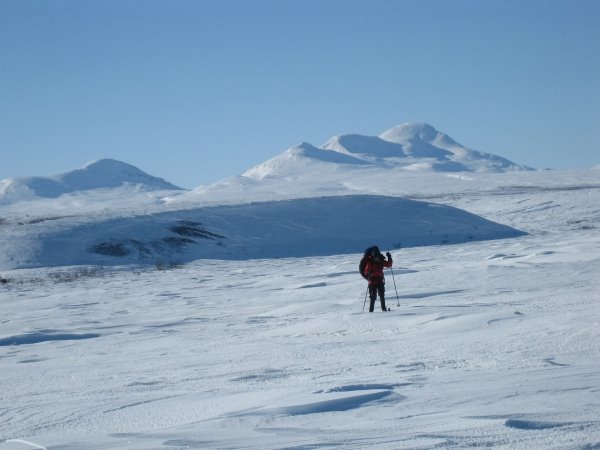
In typical fashion, our spring break trip didn't go quite as planned. This year we tried to do a 3- to 4-day ski tour near Summit Lake on the Richardson Highway. Under good conditions this would be an ideal ski tour - rolling hills above the trees with spectacular views in all directions. It's also an area that can be very wind swept.

This year the wind had formed extremely hard packed snow dunes, turning skiing into an interesting dance. Our friend SebastiƩn even managed to break his ski (almost into two seperate pieces) by straddling two of these dunes. Luckily we weren't too far from the road when that happened, and he managed to crawl/walk back to his car while we continued on.


It was a beautiful weekend, too beautiful. There were no clouds in the sky, and temperatures quickly dropped after the sun set and didn't stop until they had reached -30C (-22F). Brrr! After one night in a tent at those temperatures and after having difficulties getting our stove to light, we decided the smartest thing to do would be to head back to the car and get home.

09 March 2006

Science vs. Politics

Since I have recently been discussing (but mostly just intending to discuss) evidence for climate change and potential for anthropogenic causes, I thought I'd insert some political commentary into the mix. An editorial in the February 17th issue of Science highlights some very disconcerting news. In the past, scientists have complained that politicians, the media, and the general public don't listen to the results of their research, and in particular that they choose to ignore evidence for anthropogenic climate change. Now that the public is starting to listen, it seems that politicians want to restrict research and interpret the results on their own - and we'd better agree with them. This is a very dangerous path. Should we also let politicians be open heart surgeons, just because? Let the experts be experts. In addition to the above mentioned editorial, there is a fair amount of speculation in the science community that the current administration is encouraging exploration on Mars and the Moon in order to draw money and attention away from satellites that are observing Earth, many of which are documenting rapid climate warming and environmental degradation.

22 February 2006

Mary Shields

Martin and Dana (my advisor and his wife, pictured below with their daughter Sonja) won a bid at the Northern Alaska Environmental Center auction that was, well, a weekend at a remote cabin. They invited Inari and me to join them. All we had to do was ski 12 miles to this cabin located near Fairbanks, and everything else was provided. All of the supplies we needed were taken by dog team.


The owner of the cabin was Mary Shields, a long-time Fairbanks resident and dog musher extraordinaire. And an exceptionally generous person. For example, after being at the cabin for all of five minutes and having just met Mary, I remarked that I'd love to have a place like this to spend my weekends. She immediately responded by saying that I'm welcome anytime, and that the key is always hanging near the door.


She is quite the musher, too. She's raced in the Iditarod and Yukon Quest dog sled races many times - in fact she was the first woman to complete the Iditarod, although I didn't find that out until I got back into Fairbanks. Nowadays she works every day in the summer doing dog sled demonstrations for tourists. In winter she mushes, and each winter culminates with a month long trip somewhere in Alaska. She epitomizes Alaska (especially interior Alaska) as much as anybody I've met, and is a great example of why Fairbanks can be a great place to live.