


7 years ago
18 May 2006
Actually, one interesting thing...
I guess there was one very exciting thing that has happened in the past week. I received a young researcher travel award that will cover travel and accomodations for a one month stay in Wellington, New Zealand, this coming winter. I've been in contact with a researcher down there and we're working on ideas for possible collaborations. Not sure what will happen yet, but I'm sure it'll involve some field work and interesting discussions. Maybe (and hopefully) it'll lead to something bigger.
I'm off!
A hectic few weeks will come come to a close when I step on the plane for Greenland tonight (via New York). Again, sorry about the lack of updates lately, but there hasn't been time or anything interesting to write about. But I promise there will be plenty of pictures and stories of icebergs, isbræ, and slots when I return in July. Until then... Have a great summer!
05 May 2006
Greenland drama
As I mentioned previously, it's been a lot of work getting ready for field work in Greenland. Almost everything's been taken care of. Most of our gear is already on its way, we've got airline tickets, hotel reservations, maps, and a big grocery list. Except for two small details, we're set! Right... Yeah, except those two small details are actually pretty big deals. Last week we found out that we couldn't get a permit to operate our radio antennas, which we need in order to download GPS data remotely. The radios would help us to locate our GPS receivers after they've travelled for a year (they probably won't be that easy to find amongst all that ice!). And this week we received a permit to work near the glacier - its a World Heritage Site. But the problem is that we aren't allowed to go where we want to go for camping, optical surveying, and photography purposes. The strange thing is that people camped there last year without any troubles. And what makes this ironic is that a glaciologist was instrumental in turning the fjord into a World Heritage Site (because the glacier/fjord system is very unique), and now glaciologists aren't allowed to go there to study it. Well, anyway, the permit was a little vague so there's still hope, though we are leaving in two weeks....
One thing is for certain though - we'll be going to Greenland, just not sure what we'll be doing!
One thing is for certain though - we'll be going to Greenland, just not sure what we'll be doing!
20 April 2006
Onward to Greenland
A month from now I'll be on my way to Jakobshavns Isbrae, a glacier in western Greenland. I'll travel from Fairbanks to Albany, NY, via commercial airlines. From there we'll fly on an Air National Guard plane to Kangerlussuaq, Greenland, and then hop on a smaller plane to Ilullissat. We'll spend a few days in Ilullisaat organizing gear and double-checking everything, and then we'll take a helicopter to our camp site located at the terminus of Jakobshavns (or Sermeq Kujalleq, in Greenlandic). Check it out on Google Earth: our camp site will be located at about 69°07'30"N, 49°43'48"W. The fjord in front of the glacier that is now filled with brash sea ice was occupied by the glacier as recently as 200 years ago. The current terminus position is actually about 5-10 km back from where it appears in the Google Earth image. Sermeq Kujalleq drains 7% of the Greenland ice sheet, is up to 2500 m thick, and flows at a rate of about 15 km/yr at the terminus. Its impressive, so I'm told.
We'll be in the field for about 6 weeks, and then returning to Fairbanks via Copenhagen... We aren't able to fly with the Air National Guard on our return trip so we're forced to take the scenic route. The benefit is that we get to meet with some researchers in Copenhagen - and I'm going to take few days off and explore the city and its surroundings. So if you're going to be in the area... Let's meet!
We'll be in the field for about 6 weeks, and then returning to Fairbanks via Copenhagen... We aren't able to fly with the Air National Guard on our return trip so we're forced to take the scenic route. The benefit is that we get to meet with some researchers in Copenhagen - and I'm going to take few days off and explore the city and its surroundings. So if you're going to be in the area... Let's meet!
Something about CO2
From ice core data we have learned definitively that there is a link between CO2 and global air temperature. The following figure shows CO2 concentration and air temperature (from some reference value) as determined from an ice core in Antarctica. Similar patterns have been found in all ice cores.
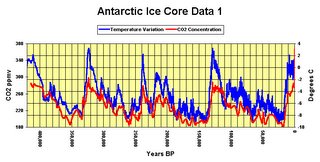
The C02 concentrations are measured in air bubbles within the ice core. Air temperature is approximated by measuring oxygen isotopes within the ice crystals themselves. Essentially, isotope fractionation occurs when water evaporates from the oceans - since oxygen-18 is heavier than oxygen-16, water molecules containing O-18 require more energy to be turned into water vapor than water molecules containing O-16. Thus the water vapor tends to be "isotopically lighter" than the oceans it has left behind. The water vapor travels poleward (due to temperature/pressure gradients) and encounters colder temperatures. Cold air can't hold as much moisture as warm air so the water vapor condenses and falls as snow or rain. Again, because it is heavier, the O-18 tends to precipitate sooner than the O-16. So it requires rather warm temperatures at all latitudes for O-18 to be found at the poles, and it can therefore be used as a proxy for air temperature.
The large, 100,000-year cycles in air temperature are what are referred to as glacial cycles. There is quite a bit of evidence that suggests that they are controlled by orbital parameters, such as the tilt of the Earth's axis, the ellipiticity of its orbit, and precession (the Earth wobbles like a top over a long time scales). Other factors are also clearly important, such as the distribution of land mass, which is important over much larger timescales (millions of years).
As I mentioned early, there is a strong correlation between atmospheric CO2 concentrations and air temperature, but from the plot above it is very difficult to determine what comes first - a change in CO2 or a change in temperature. (Methane also experiences similar oscillations.) And in fact there are reasons to believe that a rise in temperature can drive CO2 (and methane) concentrations - it can, presumably, force CO2 out of the oceans (and methane out of swamps that were previously frozen). But on the other hand, CO2 is also a "good" greenhouse gas that can trap solar radiation - more on that in a later post.
Two things to note from this figure: (1) the current interglacial period is the longest in the recent geologic past, and (2) CO2 concentrations are currently rising very rapidly and are much higher than any time in the past 400,000 years. I will also discuss this in a later post with respect to what's happened over the last 100 years - since the industrial revolution.

The C02 concentrations are measured in air bubbles within the ice core. Air temperature is approximated by measuring oxygen isotopes within the ice crystals themselves. Essentially, isotope fractionation occurs when water evaporates from the oceans - since oxygen-18 is heavier than oxygen-16, water molecules containing O-18 require more energy to be turned into water vapor than water molecules containing O-16. Thus the water vapor tends to be "isotopically lighter" than the oceans it has left behind. The water vapor travels poleward (due to temperature/pressure gradients) and encounters colder temperatures. Cold air can't hold as much moisture as warm air so the water vapor condenses and falls as snow or rain. Again, because it is heavier, the O-18 tends to precipitate sooner than the O-16. So it requires rather warm temperatures at all latitudes for O-18 to be found at the poles, and it can therefore be used as a proxy for air temperature.
The large, 100,000-year cycles in air temperature are what are referred to as glacial cycles. There is quite a bit of evidence that suggests that they are controlled by orbital parameters, such as the tilt of the Earth's axis, the ellipiticity of its orbit, and precession (the Earth wobbles like a top over a long time scales). Other factors are also clearly important, such as the distribution of land mass, which is important over much larger timescales (millions of years).
As I mentioned early, there is a strong correlation between atmospheric CO2 concentrations and air temperature, but from the plot above it is very difficult to determine what comes first - a change in CO2 or a change in temperature. (Methane also experiences similar oscillations.) And in fact there are reasons to believe that a rise in temperature can drive CO2 (and methane) concentrations - it can, presumably, force CO2 out of the oceans (and methane out of swamps that were previously frozen). But on the other hand, CO2 is also a "good" greenhouse gas that can trap solar radiation - more on that in a later post.
Two things to note from this figure: (1) the current interglacial period is the longest in the recent geologic past, and (2) CO2 concentrations are currently rising very rapidly and are much higher than any time in the past 400,000 years. I will also discuss this in a later post with respect to what's happened over the last 100 years - since the industrial revolution.
11 April 2006
Field prep
Sorry about the lack of updates lately - it's been a hectic couple of months and I don't think it will get much better anytime soon. Most people would probably take a break after defending their thesis, but not me. I'm busy running in circles trying to get equipment ready for field work. We have to have almost everything sent and on its way through Greenlandic customs (I guess Danish customs, technically) within the next couple of weeks... In retrospect I should've started preparing things sooner, but, well, too late. What this means is that I don't get to enjoy the balmy spring weather as much as I'd like, but I'll get my share of "outdoor time" later in the summer. And anyway, getting field equipment organized is a nice change from sitting in front of my computer, but then again, it is really stressful. There is a lot of time, money, resources, and work going into this field campaign and it'd be a shame to have some major problems just because we forgot to bring along the right size wrench. Plus my Ph.D. will depend largely on how things go over the next few months, so I've got a lot at stake too.
Maybe in my next few posts I'll spend some time discussing my project and field site - I don't have much else on the brain at the moment. Oh, but I did promise to talk more about carbon dioxide and global warming. Hmmm..
Maybe in my next few posts I'll spend some time discussing my project and field site - I don't have much else on the brain at the moment. Oh, but I did promise to talk more about carbon dioxide and global warming. Hmmm..
23 March 2006
Triple thesis defense week
This has been a busy week in the glaciers lab - three of the four students are defending their theses, including yours truly. I successfully defended mine on Tuesday, and can now move on to bigger things. These days the thesis defense is more of a formality than the exam that it used to be. Basically your committee won't ask you to defend unless they think you're ready to, and they are also the ones who decide whether or not you pass the defense. And, of course, it looks bad on them if they have students who fail their defense - so they want you to pass. Its become such that the thesis defense is really just an opportunity to share your work with friends and colleagues and to celebrate your accomplishments over the past few years. Since I'll be continuing on for a Ph.D., this is just one step down that road, but it still feels good!
My mom came up to see my defense; Inari and I have been busy showing her around. We saw the start of a dogsled race, went cross-country skiing, visited the museum, saw "Good night, and good luck" (a great movie), watched a moose walk past our cabin, played Carcassonne (a great tile-laying game - buy it!), and are going to view the World Ice Art Championships this afternoon, go to a triple-thesis-defense party on Friday, and swim in the hot springs on Saturday. Phew!
My mom came up to see my defense; Inari and I have been busy showing her around. We saw the start of a dogsled race, went cross-country skiing, visited the museum, saw "Good night, and good luck" (a great movie), watched a moose walk past our cabin, played Carcassonne (a great tile-laying game - buy it!), and are going to view the World Ice Art Championships this afternoon, go to a triple-thesis-defense party on Friday, and swim in the hot springs on Saturday. Phew!
16 March 2006
Our skiing adventure
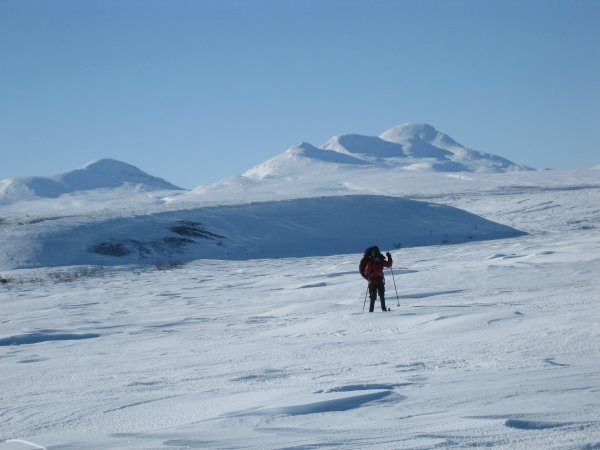
In typical fashion, our spring break trip didn't go quite as planned. This year we tried to do a 3- to 4-day ski tour near Summit Lake on the Richardson Highway. Under good conditions this would be an ideal ski tour - rolling hills above the trees with spectacular views in all directions. It's also an area that can be very wind swept.
This year the wind had formed extremely hard packed snow dunes, turning skiing into an interesting dance. Our friend Sebastién even managed to break his ski (almost into two seperate pieces) by straddling two of these dunes. Luckily we weren't too far from the road when that happened, and he managed to crawl/walk back to his car while we continued on.

It was a beautiful weekend, too beautiful. There were no clouds in the sky, and temperatures quickly dropped after the sun set and didn't stop until they had reached -30C (-22F). Brrr! After one night in a tent at those temperatures and after having difficulties getting our stove to light, we decided the smartest thing to do would be to head back to the car and get home.

This year the wind had formed extremely hard packed snow dunes, turning skiing into an interesting dance. Our friend Sebastién even managed to break his ski (almost into two seperate pieces) by straddling two of these dunes. Luckily we weren't too far from the road when that happened, and he managed to crawl/walk back to his car while we continued on.

It was a beautiful weekend, too beautiful. There were no clouds in the sky, and temperatures quickly dropped after the sun set and didn't stop until they had reached -30C (-22F). Brrr! After one night in a tent at those temperatures and after having difficulties getting our stove to light, we decided the smartest thing to do would be to head back to the car and get home.
09 March 2006
Science vs. Politics
Since I have recently been discussing (but mostly just intending to discuss) evidence for climate change and potential for anthropogenic causes, I thought I'd insert some political commentary into the mix. An editorial in the February 17th issue of Science highlights some very disconcerting news. In the past, scientists have complained that politicians, the media, and the general public don't listen to the results of their research, and in particular that they choose to ignore evidence for anthropogenic climate change. Now that the public is starting to listen, it seems that politicians want to restrict research and interpret the results on their own - and we'd better agree with them. This is a very dangerous path. Should we also let politicians be open heart surgeons, just because? Let the experts be experts. In addition to the above mentioned editorial, there is a fair amount of speculation in the science community that the current administration is encouraging exploration on Mars and the Moon in order to draw money and attention away from satellites that are observing Earth, many of which are documenting rapid climate warming and environmental degradation.
22 February 2006
Mary Shields
Martin and Dana (my advisor and his wife, pictured below with their daughter Sonja) won a bid at the Northern Alaska Environmental Center auction that was, well, a weekend at a remote cabin. They invited Inari and me to join them. All we had to do was ski 12 miles to this cabin located near Fairbanks, and everything else was provided. All of the supplies we needed were taken by dog team.
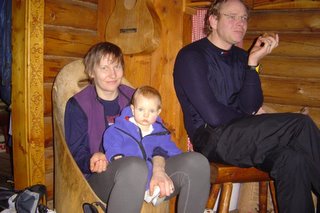
The owner of the cabin was Mary Shields, a long-time Fairbanks resident and dog musher extraordinaire. And an exceptionally generous person. For example, after being at the cabin for all of five minutes and having just met Mary, I remarked that I'd love to have a place like this to spend my weekends. She immediately responded by saying that I'm welcome anytime, and that the key is always hanging near the door.

She is quite the musher, too. She's raced in the Iditarod and Yukon Quest dog sled races many times - in fact she was the first woman to complete the Iditarod, although I didn't find that out until I got back into Fairbanks. Nowadays she works every day in the summer doing dog sled demonstrations for tourists. In winter she mushes, and each winter culminates with a month long trip somewhere in Alaska. She epitomizes Alaska (especially interior Alaska) as much as anybody I've met, and is a great example of why Fairbanks can be a great place to live.

The owner of the cabin was Mary Shields, a long-time Fairbanks resident and dog musher extraordinaire. And an exceptionally generous person. For example, after being at the cabin for all of five minutes and having just met Mary, I remarked that I'd love to have a place like this to spend my weekends. She immediately responded by saying that I'm welcome anytime, and that the key is always hanging near the door.

She is quite the musher, too. She's raced in the Iditarod and Yukon Quest dog sled races many times - in fact she was the first woman to complete the Iditarod, although I didn't find that out until I got back into Fairbanks. Nowadays she works every day in the summer doing dog sled demonstrations for tourists. In winter she mushes, and each winter culminates with a month long trip somewhere in Alaska. She epitomizes Alaska (especially interior Alaska) as much as anybody I've met, and is a great example of why Fairbanks can be a great place to live.
10 February 2006
Fairbanks Rescue Mission: a moral dilemma?
I mentioned in a previous blog that I would like to volunteer at a homeless shelter in Fairbanks. The only shelter here seems to be the Fairbanks Rescue Mission, a Christian-based organization that provides food, shelter, and clothing for Fairbanks' needy, transient, and homeless people. I don't object to religious organizations helping those in need - in fact I think its one of the most beautiful aspects of all (?) religions. What I don't agree with is when people try to impose their belief system onto others. What feels best for one person may not be the best thing for somebody else. I think all belief systems are fine, so long as they don't justify hurting somebody else or their property. Anyway, the Fairbanks Rescue Mission requires their "tenants" to attend chapel services and study the bible. I'm not sure that I want to support that... It's one thing to say that the food and shelter being provided to you comes from the grace of God - and even offer chapel services -, its another to try to forcefully convert you by taking advantage of your situation.
I'll keep searching though. Maybe there is another organization that I'm more willing to support.
I'll keep searching though. Maybe there is another organization that I'm more willing to support.
09 February 2006
The poor glaciers
At present, more than 90% of the glaciers on Earth are retreating. Of course, glacier retreat is not as simple as it may seem.
First, a little refresher: glaciers form when snow accumulation rates exceed melting rates over many years. Eventually the snow metamorphoses into ice as a result of increasing pressure in the snowpack. When the ice becomes thick enough, it deforms under its own weight and flows downhill. As the glacier reaches lower elevations, melting begins to exceed accumulation, until it reaches a point (the terminus) where the ice melts faster than it can flow forward. A change in terminus position can be due to a change in (1) air temperature, (2) snowfall, or (3) ice dynamics. Snowfall is related to air temperature, and ice dynamics is related to air temperature, snowfall, ice temperature, crystal size, and basal properties. It's clearly a difficult problem.
Furthermore, two glaciers located close to each other can behave very differently as a result of local variations in climate or dynamical processes. So the fact that over 90% of the glaciers are retreating is actually very alarming - most of the world's advancing glaciers are tidewater glaciers, which are glaciers that end in the sea and can behave independently of climate. I'd rather not get into the reasons for this, but I can point to the right direction if you're curious enough to learn more.
Evidence for glacier retreat is clear everywhere in Alaska; when walking in the mountains you can see recently-deposited moraines (rock piles left by the glaciers) that are now high above the ice surface. There is also plenty of photographic evidence - for example, see this photo at the USGS website.
A significant portion of this retreat can be attributed to natural cycles. Much of the Earth experienced a cooling period from about 1550-1850, dubbed the "Little Ice Age". And so some of this retreat is result of subsequent warming. What might not be attributed to natural causes is the increasing rate of retreat. Between the mid-1950s and mid-1990s, Alaska glaciers contributed about 0.14 mm/yr to sea level rise. Over the last 15 years, that rate has increased to closer to 0.30 mm/yr.
Glaciers in Greenland remained in pretty steady positions until the last 5 years or so. Now, all (?) glaciers south of about 68° N are rapidly retreating and accelerating. For example, Jakobshavns Isbræ, the glacier I will study for my Ph.D., has retreated 15 km in the last few years and ice flow has accelerated from 7 km/yr to ~15 km/yr at the terminus. Here's another common misconception, almost always screwed up the media and the anti-climate warming people - an accelerating glacier does not have to be advancing. The beds of the glaciers in Greenland are well below sea level. When the ice thins, it can become buoyant - this reduces the drag and also results in the rapid calving of large icebergs. (Yes, these are tidewater glaciers that can respond independently of climate, but that fact that so many of them are retreating simultaneously points to a climate-induced retreat. The popular theory at the moment is that the retreat is due to increasing ocean temperatures.)
Opponents of human-induced global warming would ask why didn't these changes happen earlier - we've been using fossil fuels for over 50 years. The answer to that is again related to the complex relationship between ice volume distribution and dynamics. Simply put, large ice masses respond slowly to changes in climate.
First, a little refresher: glaciers form when snow accumulation rates exceed melting rates over many years. Eventually the snow metamorphoses into ice as a result of increasing pressure in the snowpack. When the ice becomes thick enough, it deforms under its own weight and flows downhill. As the glacier reaches lower elevations, melting begins to exceed accumulation, until it reaches a point (the terminus) where the ice melts faster than it can flow forward. A change in terminus position can be due to a change in (1) air temperature, (2) snowfall, or (3) ice dynamics. Snowfall is related to air temperature, and ice dynamics is related to air temperature, snowfall, ice temperature, crystal size, and basal properties. It's clearly a difficult problem.
Furthermore, two glaciers located close to each other can behave very differently as a result of local variations in climate or dynamical processes. So the fact that over 90% of the glaciers are retreating is actually very alarming - most of the world's advancing glaciers are tidewater glaciers, which are glaciers that end in the sea and can behave independently of climate. I'd rather not get into the reasons for this, but I can point to the right direction if you're curious enough to learn more.
Evidence for glacier retreat is clear everywhere in Alaska; when walking in the mountains you can see recently-deposited moraines (rock piles left by the glaciers) that are now high above the ice surface. There is also plenty of photographic evidence - for example, see this photo at the USGS website.
A significant portion of this retreat can be attributed to natural cycles. Much of the Earth experienced a cooling period from about 1550-1850, dubbed the "Little Ice Age". And so some of this retreat is result of subsequent warming. What might not be attributed to natural causes is the increasing rate of retreat. Between the mid-1950s and mid-1990s, Alaska glaciers contributed about 0.14 mm/yr to sea level rise. Over the last 15 years, that rate has increased to closer to 0.30 mm/yr.
Glaciers in Greenland remained in pretty steady positions until the last 5 years or so. Now, all (?) glaciers south of about 68° N are rapidly retreating and accelerating. For example, Jakobshavns Isbræ, the glacier I will study for my Ph.D., has retreated 15 km in the last few years and ice flow has accelerated from 7 km/yr to ~15 km/yr at the terminus. Here's another common misconception, almost always screwed up the media and the anti-climate warming people - an accelerating glacier does not have to be advancing. The beds of the glaciers in Greenland are well below sea level. When the ice thins, it can become buoyant - this reduces the drag and also results in the rapid calving of large icebergs. (Yes, these are tidewater glaciers that can respond independently of climate, but that fact that so many of them are retreating simultaneously points to a climate-induced retreat. The popular theory at the moment is that the retreat is due to increasing ocean temperatures.)
Opponents of human-induced global warming would ask why didn't these changes happen earlier - we've been using fossil fuels for over 50 years. The answer to that is again related to the complex relationship between ice volume distribution and dynamics. Simply put, large ice masses respond slowly to changes in climate.
06 February 2006
Heat wave
Now that it's finally warmed up (by 70 degrees!) I've finally had the chance to enjoy the ski trails around our cabin. That's one of the best parts about life in Fairbanks: I can literally put my skis on in the driveway and start skiing into a relatively pristine forest. And, from those trails, I can connect to a whole network of dog mushing trails and frozen rivers that would take me to Nome, Barrow, and beyond. Of course I haven't done that, but I could, and it's a nice thought to know that such opportunities still exist in the world.
As Fairbanks comes out of its coldest January in 35 years, maybe its an appropriate time to talk about human-induced global warming. A friend of mine (Joe) was curious to hear what I might have to say about the subject, since I am a scientist-in-training in a related field. I could quite easily ramble on about global warming, but he was hoping for an objective response, which means I should spend some time thinking about what I say. Plus I should warn that, although my research is related to climate change, I don't spend a lot of time thinking about how humans influence climate. I do hear about these things at conferences and seminars -- I just need to review my facts.
I think I'll start by reviewing evidence for global warming and the uncertainities with those observations, and then I'll get into the more controversial stuff (depending on who you talk to). If you have certain topics to be addressed, questions, or problems with what I've said, then post away!
To be continued...
As Fairbanks comes out of its coldest January in 35 years, maybe its an appropriate time to talk about human-induced global warming. A friend of mine (Joe) was curious to hear what I might have to say about the subject, since I am a scientist-in-training in a related field. I could quite easily ramble on about global warming, but he was hoping for an objective response, which means I should spend some time thinking about what I say. Plus I should warn that, although my research is related to climate change, I don't spend a lot of time thinking about how humans influence climate. I do hear about these things at conferences and seminars -- I just need to review my facts.
I think I'll start by reviewing evidence for global warming and the uncertainities with those observations, and then I'll get into the more controversial stuff (depending on who you talk to). If you have certain topics to be addressed, questions, or problems with what I've said, then post away!
To be continued...
27 January 2006
19 January 2006
Koli National Park
Then back to Finland and onto a train that took us to eastern Finland, quite near the border with Mother Russia to visit with some friends. We had many interesting discussions on the fate of wilderness and indigenous peoples. Two of our friends living there are particularly interested in these topics; through a program called "Snowchange", which our friend started, they’ve traveled and lived with indigenous groups in remote areas of the arctic and interviewed elders about their observations of climate change. Essentially, they are trying to increase dialogue between the scientific community and local people living on the land as they have for thousands of years. If you’re interested in learning more, click here.
We made a stop at Koli National Park, the so-called “National Landscape of Finland”. Numerous poets and artists have been inspired by Koli, especially during the nationalist movement of Finland in the 19th century and early 20th century (Finland gained independence from Russia in 1917). Images of Koli have played an important role in forming the identity of the Finnish people, much in the same way as the western frontier has influenced America’s self image. Unfortunately, we were unable to take any good photos when we were there because the weather was overcast.
We made a stop at Koli National Park, the so-called “National Landscape of Finland”. Numerous poets and artists have been inspired by Koli, especially during the nationalist movement of Finland in the 19th century and early 20th century (Finland gained independence from Russia in 1917). Images of Koli have played an important role in forming the identity of the Finnish people, much in the same way as the western frontier has influenced America’s self image. Unfortunately, we were unable to take any good photos when we were there because the weather was overcast.
15 January 2006
Dunkles hefeweizen
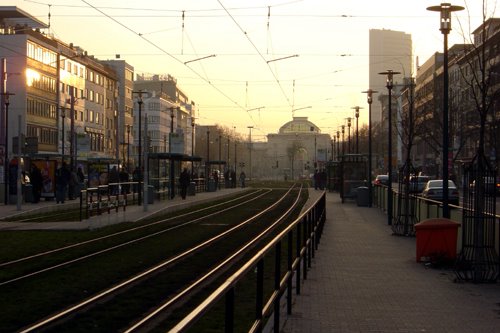 After the exciting trip to the top of Pyynikinharju, it was time for some bier und brezelen. Inari, her sister Anu, and myself visited our friend Rolland who lives in Mannheim, Germany. From the tourist’s point of view, Mannheim leaves something to be desired. It was destroyed during WWII and quickly re-built with cheap supplies, so that it lost much of the character it once had. But it is maybe the more realistic Germany (when compared to popular tourist destinations), and that made it quite interesting, especially with a local guide who was excited to show us around and answer my millions of questions about Nazism, WWII, the re-unification of Germany, the German economy, and the philosophy of beer. I’ve come to the realization that I really do enjoy learning history (previously I thought it was boring), but not the history that you learn in textbooks.
 Besides being in Mannheim we also spent one day in Worms, an old Jewish center on the River Rhein that has the oldest Jewish cemetery in Europe, and two days in Heidelberg, a popular tourist spot that was not bombed during WWII because some important American was fond of the city. I’m pretty sure I was there 10 years ago with my family, but I didn’t realize that until Rolland bought a bratwurst from what I think is the same vender that I bought one from 10 years ago (I didn’t remember the person, just the place). Heidelberg has many things to keep a visitor busy, including castle and monastery ruins, a lovely old town, the philosopher’s walk, a fairy tale park, and a Nazi theater. Our guide book said that the fairy tale park is a delight for kids, in which case I’m still a kid!
09 January 2006
The highest moraine ridge in the world
Inari’s sister lives near Pyynikinharju, which is a 200 km long moraine that was deposited by the retreating Fenno-Scandian ice sheet during the last ice age; at approximately 100 m high it is (supposedly) the highest moraine ridge in the world. A moraine is a pile of poorly sorted, angular rocks deposited by a glacier along its margin or at its terminus; they usually form when rocks that fall onto the glacier are transported downglacier and are left near the terminus as the ice melts and becomes stagnant, though in some cases moraines form when a glacier pushes sediments like a bulldozer.
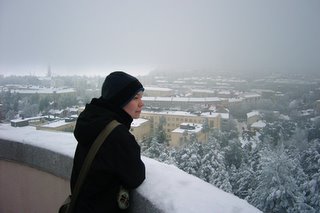 I was unable to confirm whether Pyynikinharju is the highest moraine ridge in the world for a few reasons:
 I was unable to confirm whether Pyynikinharju is the highest moraine ridge in the world for a few reasons:
- Nobody really cares.
- There seems to be some confusion in the geologic nomenclature. The Finnish word “harju” means ridge, but is often translated as esker, which it certainly is not, though both eskers and moraines are ridges. An esker is a long, sinuous ridge of sand and till deposited in a subglacial water channel. Also, the Finnish use the word “moreeni” to mean till, which is just a relatively thin layer of subglacial sediment – till is abundant in the northern plains of North America.
- I don’t understand enough Finnish to read through all the Finnish web pages discussing Pyynikinharju.
At any rate, it’s a beautiful place with great views of the city of Tampere and the two large lakes that surround it. So far it’s my favorite city in Finland.
06 January 2006
The Cave
My Grandma and I started an electronic book club about a year ago, that is, if a "club" can consist of just two people. Anyway, it's not particularly exclusive and anybody, even if you're a nobody or just somebody, can "join". The rule of the club is that any books we read must have been written by somebody who won the Nobel Prize for Literature, but the book need not be the author's most famous or even written prior to receiving the prize. Other than that, anything goes. We've made it through the following books so far:
1. Quo Vadis by Henryk Sientkiewicz
2. A Personal Matter by Oe Kenzaburo
3. Beloved by Toni Morrison
4. For Whom the Bell Tolls by Ernest Hemingway
5. Midaq Alley by Naguib Mahfouz
6. The Cave by José Saramago
Each book has been special for its own reasons, but some have been more special than others. We've already visited ancient Rome, modern Japan, slavery, the Spanish Civil War, Cairo, and the "Center". Sometimes we've visited topics we would've preferred not to have visited, but maybe we're better off for having done so.
We most recently finished The Cave, a story about an elderly potter, his daughter and son-in-law, and a dog called Found. The story itself isn't so important, its the poetic and insightful writing that makes this book a fun read. Paragraphs often surpassed three or four pages, some sentences were up to a page long and full of commas. Dialogue was not seperated in the usual style, but rather by commas and capital letters. This made it difficult to follow at times, until you realized that it didn't matter who said the words, only that they were said. Saramago is really a poet, but maybe he realized that he would have a better chance of making a living by writing stories. This story is really a poem, disguised by a plot. Read it for the word play, but stay and enjoy the symbolism, for which there is a lot: the circularity of life, self-discovery, individuality, the dangers of mass marketing, Plato's cave, and pottery (believe me, there is a common thread through these things).
So, what's next?
1. Quo Vadis by Henryk Sientkiewicz
2. A Personal Matter by Oe Kenzaburo
3. Beloved by Toni Morrison
4. For Whom the Bell Tolls by Ernest Hemingway
5. Midaq Alley by Naguib Mahfouz
6. The Cave by José Saramago
Each book has been special for its own reasons, but some have been more special than others. We've already visited ancient Rome, modern Japan, slavery, the Spanish Civil War, Cairo, and the "Center". Sometimes we've visited topics we would've preferred not to have visited, but maybe we're better off for having done so.
We most recently finished The Cave, a story about an elderly potter, his daughter and son-in-law, and a dog called Found. The story itself isn't so important, its the poetic and insightful writing that makes this book a fun read. Paragraphs often surpassed three or four pages, some sentences were up to a page long and full of commas. Dialogue was not seperated in the usual style, but rather by commas and capital letters. This made it difficult to follow at times, until you realized that it didn't matter who said the words, only that they were said. Saramago is really a poet, but maybe he realized that he would have a better chance of making a living by writing stories. This story is really a poem, disguised by a plot. Read it for the word play, but stay and enjoy the symbolism, for which there is a lot: the circularity of life, self-discovery, individuality, the dangers of mass marketing, Plato's cave, and pottery (believe me, there is a common thread through these things).
So, what's next?
01 January 2006
Finnish New Year
New Year’s Eve is the only time of year that a permit is not required to shoot off fireworks in Finland. Of course, some people get a little bit antsy and start firing them off as much as two or three days before New Year’s Eve. Come December 31, everybody is shooting them off – all night long. The result is spectacular, and a little bit crazy. I suspect it’s a little bit like being in a war zone: step outside your house and you are immediately surrounded by explosions, you never know when or from which direction the next one will come. My favorite “fireworks” were the emergency flares; normally it is illegal to fire these unless there is an emergency, except, of course, on New Year’s Eve. The flares look like bright red jellyfish slowly floating through the sky.
Subscribe to:
Posts (Atom)


